The Solution
Strengthening Accuracy And Throughput
The Lyngsoe High-Speed RFID Reader is a standardized, configurable inline RFID solution designed for high-speed sortation systems and fixed industrial scanner applications.
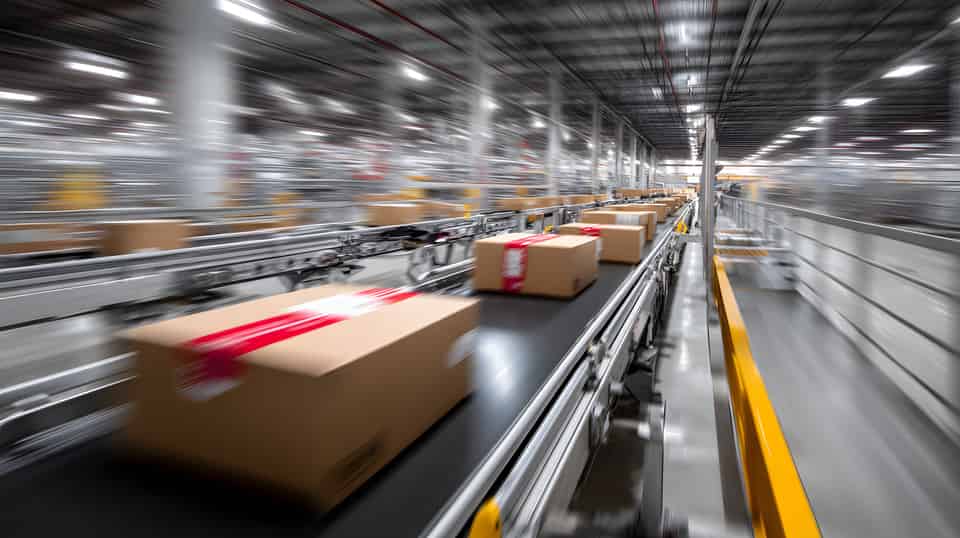
It enables automated, real-time identification of items moving at high speed on conveyors, either as a stand-alone solution or by enhancing existing scan technologies with RFID data—delivering more complete and reliable item information at each read point.
Installed at induction or upstream conveyor sections, the solution operates inline and enriches data from barcode, vision and dimensioning systems. This improves identification accuracy and supports more precise decisions in downstream sortation and control processes.
By consolidating multiple data sources into a single, consistent item identity, the solution strengthens flow efficiency and improves overall system performance.
Get in Touch
Why It Matters
In high-volume sortation environments, even small gaps or inconsistencies in identification data can lead to misrouting, delays, and unnecessary manual handling.
The Lyngsoe High-Speed RFID Reader addresses this by complementing existing technologies with inline RFID, strengthening data reliability and enabling more accurate decisions throughout the operation.
The result is smoother flow, fewer exceptions, and more stable high-volume performance.
Simple And Cost-Efficient Implementation
The Lyngsoe High-Speed RFID Reader integrates seamlessly into existing high-speed sortation and fixed industrial scanner systems without requiring major mechanical or operational changes.
Unlike traditional RFID tunnel solutions, it does not require bulky enclosures or extensive reconstruction to create dedicated read zones. Operating inline at existing capture points, it simplifies installation and avoids costly modifications to conveyor layouts.
Its modular design enables straightforward deployment across both new and existing conveyor lines, reducing installation effort and accelerating time to value.
By building on existing infrastructure rather than replacing it, the solution provides a cost-efficient path to improved data quality, higher throughput, and better overall system performance.
Performance Highlights
Under standard conditions and with system tuning*, the solution delivers reliable, high-speed performance:
| Parameter: | Performance: |
| Belt speed (max) | 540 ft/min |
| Item separation (minimum) | 1 ft |
| Read rate performance | > 99.9% |
*) Performance can be further optimized through application-specific system tuning
System Components
The solution is built on industry-proven, best-in-class components designed for consistent and reliable performance:
- High-performance RFID reader: High-performance RFID reader powered by Zebra Technologies for consistent and reliable tag capture.
- Scalable RFID antenna configuration:
o Single antenna (top-mounted) – standard configuration
Suitable for controlled environments where RFID labels have a consistent orientation. Delivered as an out-of-the-box solution enabling reliable high-speed data capture with a simple and cost-efficient setup.
o Dual antenna (top + under-belt) – standard configuration
Designed for applications where label orientation cannot be controlled. A combination of top-mounted and under-belt antennas ensures consistent read performance regardless of tag position, with a ready-to-deploy setup.
o Multi-antenna configurations – extended coverage
For scenarios where both outer labels and RFID-tagged items inside cartons or bags need to be captured, the antenna setup can be easily adjusted and fine-tuned to ensure complete and reliable data capture.
Software
The embedded Lyngsoe High-Speed RFID Reader software is designed for real-time performance and ease of use:
- Real-time singulation algorithm: Intelligent tag-matching algorithm optimizes read accuracy and throughput based on flow conditions
- Cross-read suppression: Ensures only RFID tags associated with the target item are read, eliminating interference from nearby items
- Configuration interface: Simple setup of run-time parameters
Interfaces
The system integrates seamlessly with high-speed sortation systems and fixed industrial scanner applications via embedded interfaces:
- TCP/IP interface: Enables read-on-demand functionality and supports communication with sortation systems, scanner environments, and higher-level control systems
- Other interface protocols available on request
Global Service and Lifecycle Support
The Lyngsoe RFID Tunnel Reader is supported by Lyngsoe’s global service program, ensuring long-term performance through expert support and comprehensive lifecycle services.

Our Success Stories
See how we help customers improve visibility, efficiency, and operational performance across complex logistics operations.
Stay updated
Get the latest news, product updates, and insights delivered to your inbox.

What is an RFID tunnel used for in warehouse operations?
An RFID tunnel is used to automatically verify the contents of cartons, totes, or shipments as they move through warehouse conveyor systems. It helps distribution centers and logistics operations validate SKUs, quantities, and shipment accuracy in real time without manual scanning. RFID tunnel systems are commonly used to improve inventory accuracy, reduce shipping errors, and automate inbound and outbound verification processes.
How does RFID carton verification improve supply chain accuracy?
RFID carton verification enables real-time validation of products inside cartons before they are received or shipped. By automatically confirming SKU quantities and order accuracy, companies can reduce picking and packing errors, prevent incorrect shipments, and improve inventory reliability across warehouse and distribution operations.
Do all RFID tunnel systems require shielding and physical tunnel structures?
Traditional RFID tunnel systems often rely on shielding and physical tunnel enclosures to control read zones and prevent interference. The Lyngsoe RFID Tunnel takes a different approach by eliminating the need for physical tunnel structures while still delivering highly accurate carton validation in conveyor-based environments. This reduces deployment complexity, lowers installation costs, and makes integration into existing warehouse operations faster and more flexible.
Can RFID tunnel solutions integrate with WMS, ERP, and warehouse automation systems?
Yes. the RFID tunnel systems from Lyngsoe are designed to integrate directly with warehouse management systems (WMS), ERP platforms, PLCs, and conveyor controls. The Lyngsoe RFID Tunnel supports industry-standard protocols such as MQTT, OPC-UA, TCP/IP, EPCIS, and JSON, enabling seamless real-time communication between RFID infrastructure and existing supply chain and warehouse automation systems.
What are the advantages of RFID tunnels compared to barcode scanning?
RFID and barcode technologies are often used together in modern warehouse operations rather than as direct replacements for one another. Barcode scanning remains highly effective for item-level identification and low-cost workflows, while RFID adds automated, high-speed validation capabilities for cartons, pallets, and conveyor-based operations. Unlike traditional barcode scanning, RFID technology can read multiple tagged items simultaneously without requiring line-of-sight scanning. This enables warehouse operations to automatically validate entire cartons while moving through the conveyor flow, reducing manual handling and improving throughput. Many supply chain organizations use a hybrid approach where barcodes and RFID complement each other. For example, barcode scanners can identify carton IDs while RFID verifies the carton contents in real time. The Lyngsoe RFID Tunnel supports this approach through optional barcode integration, enabling accurate and scalable verification for high-volume logistics environments.
What should companies look for in an end-to-end RFID solution provider?
hen evaluating RFID solution providers, companies should look beyond hardware specifications and consider implementation experience, integration capabilities, scalability, and long-term support.
Successful RFID deployments often require seamless integration into warehouse operations, ERP/WMS platforms, and automation systems while maintaining high read accuracy in demanding environments. Lyngsoe provides integrated RFID solutions designed for warehouse automation and supply chain visibility, including RFID readers, tags, antennas, software, integration into ERP, WMS, and automation platforms, as well as global service and support.
With more than 15,000 RFID installations worldwide, Lyngsoe has extensive experience delivering reliable RFID solutions for complex, high-throughput operations.
What support should you expect from an RFID solution provider?
RFID systems are often critical to daily warehouse and logistics operations, making long-term service and support an important part of any deployment. Companies should expect support throughout the entire solution lifecycle, including deployment, integration, optimization, maintenance, and ongoing technical assistance. Lyngsoe supports customers through a global service and lifecycle program designed to ensure stable performance and long-term operational reliability. This helps supply chain organizations maintain uptime, adapt to changing operational requirements, and maximize the value of their RFID investment over time.
How accurate are RFID tunnel systems?
Modern RFID tunnel systems are designed to deliver highly accurate carton and shipment verification in fast-moving warehouse environments. Read accuracy depends on factors such as tag quality, carton composition, conveyor speed, and system configuration, but advanced RFID solutions can achieve verification accuracy above 99%. The Lyngsoe RFID Tunnel is designed for reliable, real-time validation in both inbound and outbound flows, with verification accuracy above 99.9% under standard conditions. Features such as intelligent read algorithms and cross-read suppression help ensure that only tags within the target carton are captured, supporting accurate inventory data and reducing shipping and fulfillment errors.
Can RFID tunnels handle high-speed conveyors?
Yes. RFID tunnel systems are commonly designed for high-throughput warehouse and logistics operations where cartons move continuously through conveyor flows. Advanced RFID solutions use optimized antenna configurations and real-time read algorithms to maintain high accuracy even at higher conveyor speeds.
The Lyngsoe RFID Tunnel supports conveyor speeds up to 1.6 m/s (315 ft/min) under standard conditions while maintaining reliable verification performance. This enables supply chain operations to automate carton validation without slowing throughput or compromising operational efficiency.
How do you deploy RFID in existing warehouses?
Modern RFID solutions can often be deployed into existing warehouse environments without major infrastructure changes. Many companies implement RFID as part of a phased automation strategy, allowing them to improve inventory visibility and process validation while maintaining ongoing operations. The Lyngsoe RFID Tunnel is designed for simple integration into live warehouse environments. As a non-intrusive, stand-alone solution, it can be mounted directly on or above existing conveyors without requiring physical tunnel structures or shielding. This helps reduce installation complexity, minimize operational disruption, and accelerate deployment timelines.